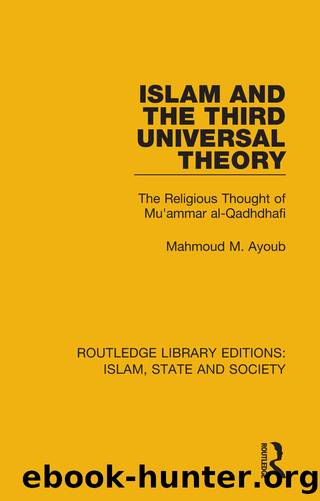
Islam and the Third Universal Theory: The Religious Thought of Mu'ammar Al-Qadhdhafi by Mahmoud M. Ayoub
Author:Mahmoud M. Ayoub [Ayoub, Mahmoud M.]
Language: eng
Format: epub
Tags: Religion, Social Science, Political Science, Islamic Studies, General
ISBN: 9781315312279
Google: V_p5DQAAQBAJ
Goodreads: 32957522
Publisher: Routledge
Published: 1987-03-01T00:00:00+00:00
Islam and the Political Challenge
No religious tradition, and Islam in particular, can be reduced to a mere set of beliefs and practices. The impassioned objections which Qadhdhafi raised to the assembled ulama' concerning the prevalent view of Islam today could be summed up in a view of Islam as an important catalyst of reform and social change, rather than as a system able to serve the limited interests of one decadent class in society. It is on this practical social level that the roles of religion and politics become closely interrelated. The issue of the role of religion in society is especially important for the Muslim community, which refuses to separate its faith from its social and political affairs, in spite of the criticisms of traditional Islam both by Western and Muslim intellectuals and political thinkers. Qadhdhafi's view of Islam and its function as an instrument of progress and revolutionary change is typical of all movements of Islamic revival.
Qadhdhafi believes that Islam, which provided the basis and impetus for a rich, prosperous and strong Muslim community in the past, is still capable of raising Muslim society now to its former state of power and glory. This he succinctly expressed in his address in July 1983, to a youth gathering in Moravia. He began by insisting that Islam must be politically effective. A person's faith and observance of the fundamentals of Islam will be well rewarded by God, but this in itself is not sufficient. It is necessary for Islam to be an effective basis of collective action among Muslim nations, Qadhdhafi argued. These nations must support all revolutionary liberation movements, regardless of whether they are or are not Islamic. He voiced disappointment with the fact that non-Muslim countries in Africa are progressive, while Muslim countries are generally reactionary, serving the interests of imperialism and colonialism. 'Islam must', Colonel Qadhdhafi asserted, 'constitute a united political power capable of safeguarding the interests of its adherents, so long as they are Muslims united by a common faith, a common scripture, a common Prophet and a common qiblah [direction of prayer]. These common religious factors must in the end be translated into political activity that would defend the people of this faith, protect them and create in them a sense of fraternal responsibility towards one another. Otherwise, Islam would mean nothing to its people.'91
Islamic traditions, practices and important occasions must, Qadhdhafi believes, be used to strengthen the political and social bond among Muslims. In a sermon which he delivered on the occasion of 'id al-adha (feast of sacrifice) in November 1978, he argued, 'As for the prayers of the two 'ids, they are a conference which brings Muslims together.' (They are usually performed in the open, so as to allow the largest possible number of people to participate in them.) In the mosque, he further argued, the world must be left behind, and only the name of God is to be remembered. But in this open 'conference of worship', Qadhdhafi asserted, 'We must also discuss politics, social issues, and all our wordly affairs and problems.
Download
This site does not store any files on its server. We only index and link to content provided by other sites. Please contact the content providers to delete copyright contents if any and email us, we'll remove relevant links or contents immediately.
| Anthropology | Archaeology |
| Philosophy | Politics & Government |
| Social Sciences | Sociology |
| Women's Studies |
Cecilia; Or, Memoirs of an Heiress — Volume 1 by Fanny Burney(32561)
The Great Music City by Andrea Baker(32021)
Cecilia; Or, Memoirs of an Heiress — Volume 2 by Fanny Burney(31958)
Cecilia; Or, Memoirs of an Heiress — Volume 3 by Fanny Burney(31944)
We're Going to Need More Wine by Gabrielle Union(19050)
All the Missing Girls by Megan Miranda(16038)
Pimp by Iceberg Slim(14515)
For the Love of Europe by Rick Steves(14149)
Bombshells: Glamour Girls of a Lifetime by Sullivan Steve(14078)
Talking to Strangers by Malcolm Gladwell(13375)
Norse Mythology by Gaiman Neil(13372)
Fifty Shades Freed by E L James(13245)
Mindhunter: Inside the FBI's Elite Serial Crime Unit by John E. Douglas & Mark Olshaker(9346)
Crazy Rich Asians by Kevin Kwan(9295)
The Lost Art of Listening by Michael P. Nichols(7507)
Enlightenment Now: The Case for Reason, Science, Humanism, and Progress by Steven Pinker(7315)
The Four Agreements by Don Miguel Ruiz(6767)
Bad Blood by John Carreyrou(6625)
Weapons of Math Destruction by Cathy O'Neil(6283)
